

Industrial HVAC Failures Don’t Happen Overnight – Here’s What to Do Before One Costs You a Shutdown
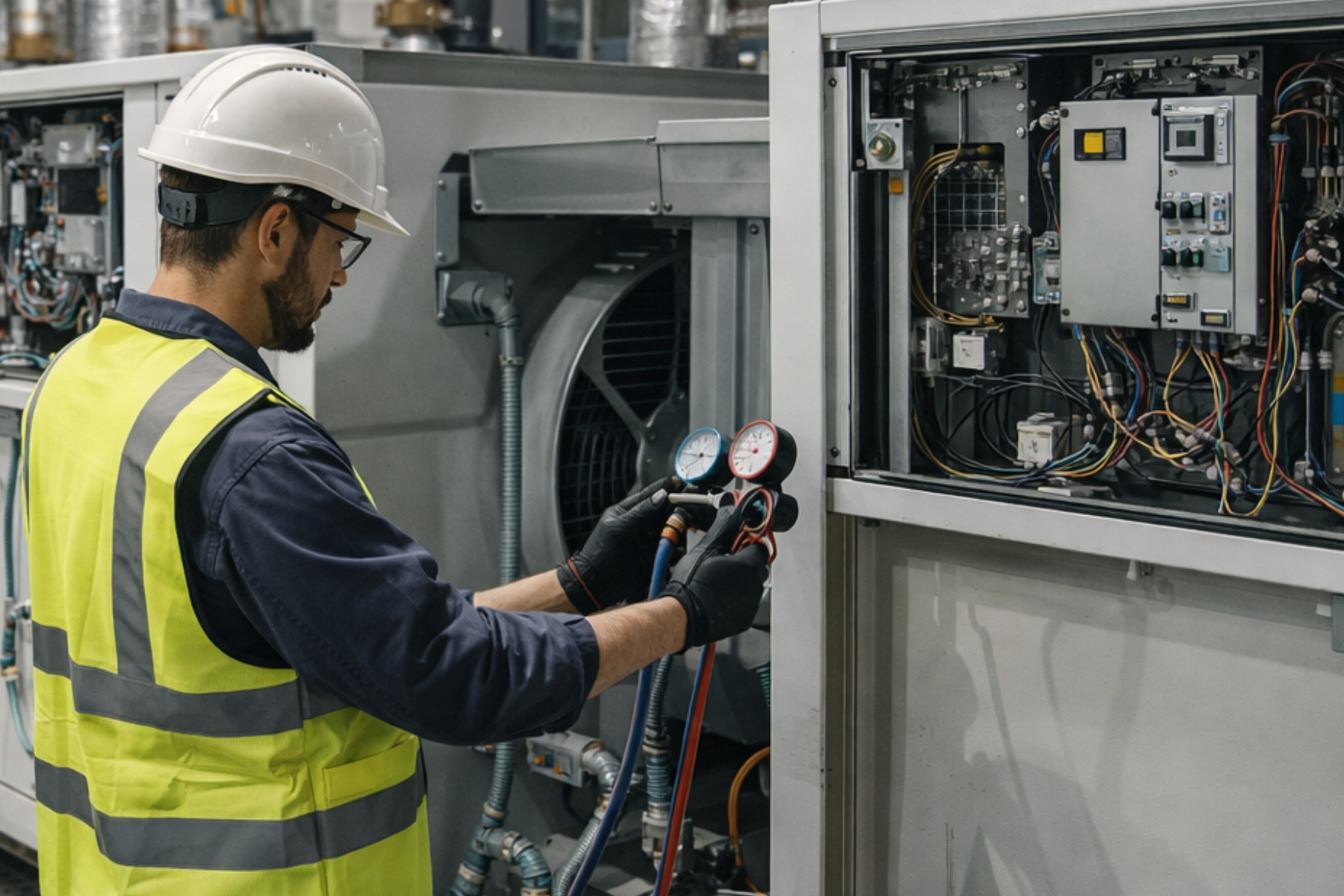
Most industrial HVAC failures that shut down a line, spike temperatures in a critical space, or force an emergency call at 2 a.m. on a Saturday didn’t happen suddenly. They built. Slowly. Over months — sometimes years — of deferred maintenance, incremental degradation, and warning signs that got logged but not acted on.
For plant managers, maintenance leaders, and reliability teams, understanding how industrial HVAC failure actually unfolds — and what a credible prevention strategy looks like — is the difference between managing the system and being managed by it.
This post breaks down the real causes of industrial HVAC failure, the signs that often go unaddressed, what a structured maintenance approach should include, and when it makes sense to bring in a contractor partner rather than try to hold things together with internal resources alone.
Industrial HVAC Is Not Commercial HVAC
Before getting into failure patterns, it’s worth establishing one foundational point: industrial HVAC systems are fundamentally different from commercial building systems, and they need to be treated that way.
In an industrial facility — a manufacturing plant, a process facility, a water or wastewater treatment site, a heavy industrial campus — HVAC systems are doing more than keeping people comfortable. They are:
- Controlling ambient temperatures in spaces where process equipment operates within defined thermal tolerances
- Managing humidity in environments where materials, coatings, or products require stable conditions
- Supporting ventilation in areas with airborne particulates, chemical exposure, or combustible dust
- Providing process cooling that is directly tied to production uptime
- Protecting electrical rooms, control rooms, and MCC spaces where heat events cause equipment failures
- Meeting OSHA and EHS requirements tied to worker health and safety
When an industrial HVAC system fails, the downstream consequences are not just comfort-related. They are operational. A failed air handling unit in a process area can trigger a production hold. A failed chiller loop can take down cooling-dependent equipment. A compromised ventilation system in a hazardous area creates a compliance and safety exposure that cannot be deferred.
This is the operating reality that shapes everything else in this post.
How Industrial HVAC Failures Actually Build
Walk through the failure timeline of most significant industrial HVAC breakdowns and you’ll find a consistent pattern. It rarely looks like a sudden catastrophic event. It looks like a series of deferred decisions.
Stage 1: Early Warning Signs That Get Normalized
The first signs of an HVAC system under stress are usually subtle enough that they get absorbed into the baseline of “things we’re watching.” Slightly elevated discharge temperatures. A unit running a little longer than usual. A vibration that maintenance knows about but has been stable for a while. A filter that’s getting changed more often than it used to.
These early indicators are meaningful. They signal that the system is working harder than it should — that something in the balance of the system has shifted. But in a busy plant environment with limited maintenance resources and a full work order queue, they often get a note in the log and not much else.
Stage 2: Degradation Accelerates Under Stress
Industrial HVAC systems that are already operating under stress — dirty coils, low refrigerant, worn belts, fouled heat exchangers, aging compressors — don’t hold steady. They deteriorate faster as the system compensates for the weakest points. A compressor that’s working 20% harder than it should be is aging faster than its spec suggests. A coil that hasn’t been properly cleaned in two years is reducing system efficiency in ways that compound across every component downstream.
At this stage, the unit may still be “running,” and that becomes the standard by which decisions get made. It’s running. It hasn’t failed. We’ll get to it.
Stage 3: The Trigger Event
The trigger is usually something that, in a healthy system, would have been a non-event. An unusually hot stretch. A production demand spike. A power fluctuation. A weekend where no one caught that the system was struggling. The weakened system hits a threshold it can no longer absorb, and failure follows.
At that point, the emergency begins — the calls, the scramble for parts, the rental equipment, the contractor mobilized on emergency rates, the production impact while the fix comes together. The cost of the emergency is almost always significantly higher than what a proactive approach would have required.
This pattern is not a mystery. It is predictable. And it is preventable.
Warning Signs Maintenance Teams Should Not Normalize
These are the signals that warrant action, not just documentation:
Temperature and Performance Indicators
- Discharge air temperatures trending warmer than setpoint without a clear cause
- Longer run cycles to achieve the same conditioning result
- Spaces that used to hold setpoint now running warmer during peak load
- Compressor high-pressure or low-pressure lockouts that reset and recur
Mechanical and Structural Indicators
- Unusual vibration in air handling units, compressors, or fan assemblies
- Bearing noise or elevated bearing temperatures
- Belt wear or glazing more frequent than expected
- Coil damage, corrosion, or physical fouling visible during walkthroughs
- Drain pans with standing water, algae, or signs of blockage
Electrical and Control Indicators
- Elevated amperage draw on motors or compressors
- Control boards or thermostat systems cycling erratically
- Contactors and relays showing signs of wear or heat damage
- BAS or building management system alerts that are being silenced without root-cause investigation
Refrigerant and Fluid System Indicators
- Refrigerant loss requiring recharges more than once in a season
- Chilled water system pressure inconsistencies
- Condenser water temperatures trending outside normal range
- Cooling tower performance degradation in water-cooled systems
Any one of these, occurring in isolation and addressed promptly, is manageable. Multiple indicators present simultaneously — especially in an aging system — should be treated as an active risk, not a watch-and-see situation.
What a Real Industrial HVAC Preventive Maintenance Program Includes
Preventive maintenance programs that actually protect uptime look different from the basic annual service check. In an industrial facility, a credible PM program for HVAC systems should include:
Scheduled Inspections at the Right Frequency
Not all HVAC systems in an industrial facility operate under the same load, environmental stress, or criticality level. A PM program should be frequency-stratified based on:
- System criticality (what goes down if this unit fails?)
- Operating hours and duty cycle
- Environmental exposure (dust, moisture, chemicals, heat)
- Age and condition baseline
High-criticality systems — process cooling, electrical room conditioning, critical production area ventilation — warrant monthly inspection at minimum. Supporting systems can be scheduled less frequently, but should still have defined inspection cadence, not just “when it seems like it needs it.”
Coil Cleaning and Heat Transfer Maintenance
Fouled coils are one of the most common contributors to reduced HVAC efficiency and accelerated component wear in industrial environments. Evaporator coils collect dust, debris, and biological growth. Condenser coils exposed to outdoor conditions accumulate dirt and can corrode. In industrial environments with airborne particulates, fouling happens faster than in office buildings.
Coil cleaning should be a defined, scheduled activity — not an afterthought. The efficiency loss from a heavily fouled coil can exceed 20-30%, meaning the system is running harder and costing more to deliver less conditioning.
Refrigerant and Fluid System Monitoring
Refrigerant management is not just about topping off a charge when performance drops. It involves tracking charge levels over time to identify loss trends, checking for leaks before loss becomes significant, and confirming that the system is operating at design pressures and temperatures. In chilled water systems, it also includes monitoring fluid chemistry, pH, and inhibitor levels to prevent scale buildup and corrosion in heat exchangers and piping.
Mechanical Component Inspection and Replacement
Belts, bearings, motors, and drive components have service life. In a well-run PM program, component replacement happens on schedule and condition, not just at failure. Predictive tools — vibration analysis, infrared thermography, motor current analysis — can provide early warning on components showing fatigue before they fail.
Controls and BAS Verification
Control systems that aren’t calibrated or validated against actual operating conditions can cause HVAC systems to run inefficiently, miss setpoints, or operate outside design parameters in ways that compound mechanical wear. PM programs should include control system verification: confirming that sensors are accurate, setpoints are appropriate, and control sequences are functioning as designed.
Documentation That Creates Operational Intelligence
A PM program produces records. Those records, over time, create a maintenance history that is genuinely useful for identifying trends, justifying capital expenditure, planning upgrades, and making the case for replacing systems that have reached end of cost-effective useful life. Maintenance teams that have strong documentation are better positioned to make decisions based on data rather than feel.
When Preventive Maintenance Isn’t Enough: Retrofits and System Upgrades
There is a point in the life of an industrial HVAC system where continued repair and maintenance investment produces diminishing returns. Reaching that point is not a failure — it is a predictable outcome of operating complex mechanical equipment in demanding environments.
Indicators that retrofit or replacement may be more cost-effective than continued repair include:
- Recurring failures in the same components despite repair
- Parts availability becoming limited or lead times extending significantly
- Refrigerant type requiring replacement due to phase-out regulations (R-22, for example)
- Efficiency significantly below modern equipment benchmarks, increasing energy cost
- Inability to meet current load demands due to capacity decline
- Controls systems that cannot interface with modern BAS platforms
Retrofits and upgrades in industrial environments require planning beyond equipment selection. They require sequencing that minimizes operational disruption, coordination with production and operations schedules, mechanical and electrical integration into existing plant infrastructure, and often structural or foundation considerations depending on equipment size and location.
A contractor partner who can execute across mechanical services, electrical work, and concrete and structural scope — rather than managing separate specialty subs — reduces coordination burden and schedule risk significantly.
The Self-Perform Advantage in Industrial HVAC Work
One of the most underappreciated factors in industrial HVAC contracting is the difference between a contractor who self-performs the work and one who brokers it to subcontractors.
In industrial environments, where safety requirements, shutdown windows, and production schedules leave limited margin for delays, coordination failures, or scope gaps, a self-performing contractor provides:
Accountability without gaps. When one contractor is responsible for mechanical, electrical, controls, and structural scope, there is no gray area between trades about who owns what. Scope gaps don’t become schedule problems.
Faster mobilization. A self-perform contractor dispatches its own crews. There is no waiting for a subcontractor to schedule and mobilize. For emergency and urgent response situations, this matters significantly.
Consistent safety and quality standards. Crews who work together regularly, under consistent safety culture and quality expectations, perform differently than an ad-hoc team assembled from multiple subs.
Tighter schedule control. When the contractor controls the labor, they control the schedule. Sequencing decisions can be made in real time, without the friction of coordinating between multiple companies.
Lee Contracting’s industrial contracting capabilities are built on this self-perform foundation — mechanical, electrical, rigging, fabrication, and civil scope executed by Lee crews, under Lee standards, on your schedule.
What a Good Partner Looks Like
Not every HVAC issue in an industrial facility warrants a contractor. Internal maintenance teams handle a significant volume of routine work every day — and they should. The question is knowing where the line is, and having a contractor relationship ready before you need it urgently.
A good contractor partner for industrial HVAC work brings:
Honest assessment, not sales. When your contractor evaluates a system, the output should be a clear picture of what’s there, what the risks are, and what the options are — not a proposal to replace everything. Trust is built on straight answers, not inflated scopes.
Real-world scheduling flexibility. Industrial HVAC work often has to be executed around planned shutdowns, production windows, or maintenance outages. A contractor who can work within your schedule — including nights, weekends, and compressed windows — is a fundamentally different partner than one who only works standard hours.
Capability breadth that matches industrial scope. HVAC work in an industrial facility rarely lives in isolation. It touches electrical, controls, structural supports, rigging for equipment removal or installation, and sometimes process systems. A contractor who can handle that breadth without layering in multiple subs is a genuine operational advantage.
History in industrial environments. Plant environments have safety requirements, permitting processes, and operational realities that contractors without industrial experience are not prepared for. Lock-out/tag-out compliance, confined space awareness, hot work permitting, coordination with operations — these are baseline expectations, not added services.
Don’t Wait for the Breakdown to Find Your Service Provider
The industrial HVAC failures that cost the most — in downtime, in emergency service rates, in production impact, in scrambled schedules — are almost always the ones that could have been caught. The warning signs were there. The maintenance window existed. The decision got deferred.
Lee Contracting works with industrial facilities across the region to build maintenance programs that prevent those failures, execute planned repairs and retrofits during scheduled windows, and respond when something goes wrong and needs to be right quickly.
Whether you’re managing an aging HVAC system that’s showing signs of stress, planning a retrofit during an upcoming outage, or evaluating your current PM program against what it should be doing, we’re a direct conversation away.
Contact Lee Contracting to talk through your facility’s HVAC needs with a team that understands what industrial maintenance actually demands.
Frequently Asked Questions:
How often should industrial HVAC systems be serviced?
Frequency should be based on criticality, operating environment, and equipment age. High-criticality systems — process cooling, electrical room conditioning, critical production spaces — should be inspected monthly at minimum, with comprehensive service at least twice per year. Supporting systems can typically operate on quarterly or semi-annual schedules. Any system showing active performance indicators should be evaluated immediately, regardless of where it falls in the PM calendar.
What causes most industrial HVAC failures?
The most common contributors are deferred maintenance (fouled coils, worn belts, low refrigerant), aging components operating beyond their effective service life, controls issues that cause systems to operate outside design parameters, and environmental fouling from industrial processes that accelerate degradation. Most failures are preceded by warning signs that were present but not acted on.
When does it make sense to retrofit or replace rather than continue repairing?
When repair costs are recurring frequently, parts availability is declining, the equipment uses a phased-out refrigerant, or the system can no longer meet facility load requirements cost-effectively, retrofit or replacement becomes the more economical long-term decision. A qualified contractor can help evaluate the lifecycle cost comparison.
What should a plant look for in an industrial HVAC contractor?
Look for a contractor with demonstrated experience in industrial environments, self-perform capability across mechanical and electrical scope, a clear safety culture aligned with plant requirements, and the ability to work within your scheduling constraints. Avoid contractors who approach industrial sites with a commercial HVAC mindset — the operational requirements are fundamentally different.
How quickly can Lee Contracting respond to an emergency HVAC situation?
Lee Contracting maintains maintenance and repair support capabilities designed for industrial responsiveness. Contact us directly to discuss your facility’s needs and establish response expectations before an emergency requires it.
