

Concrete Foundations for Heavy Industrial Equipment: How to Get It Right Before the Pour
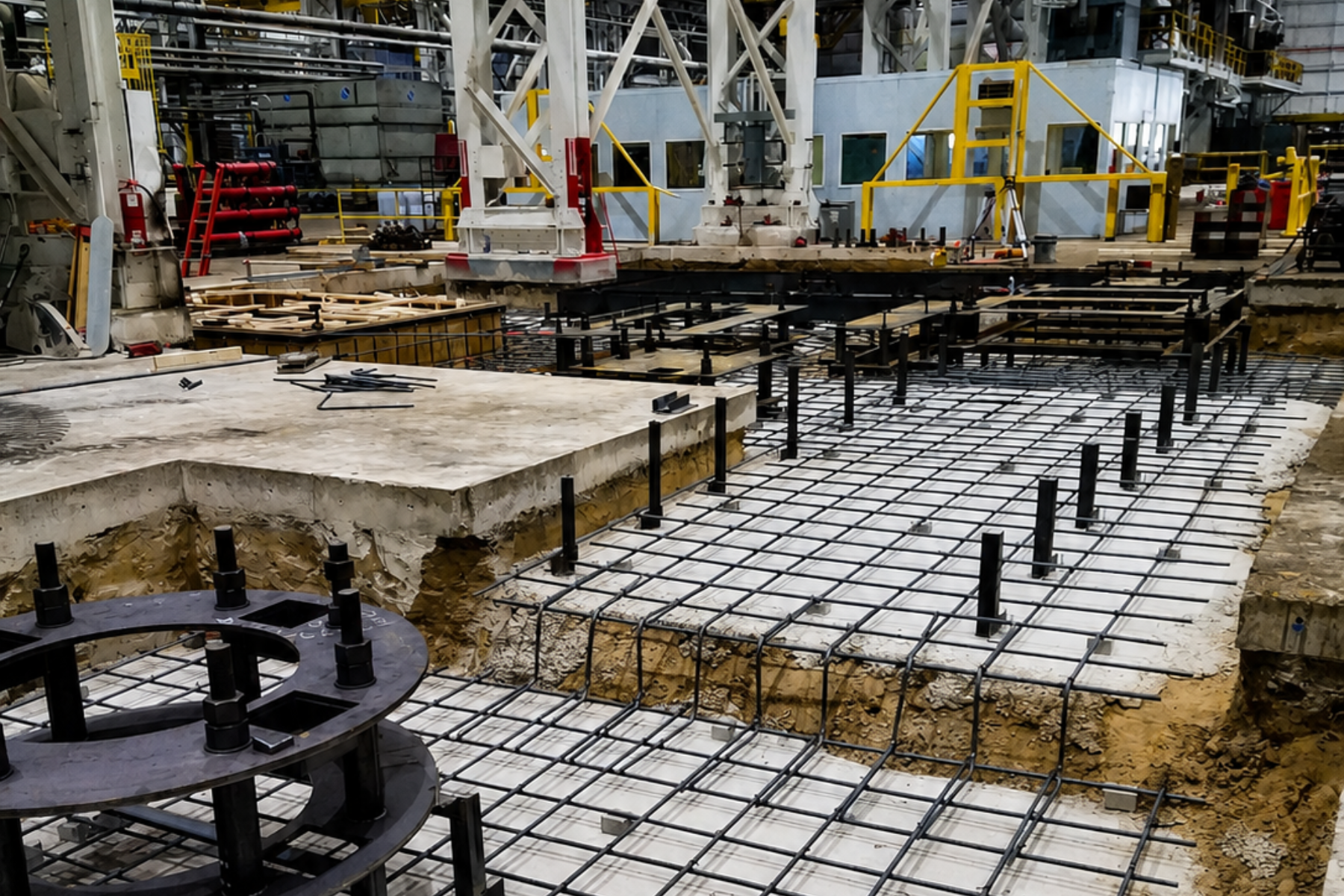
Concrete foundations for heavy industrial equipment are precision work. The pad must transfer static and dynamic loads, resist vibration at operating frequency, and hold anchor bolts in exact position so the machine can be set and aligned to spec. That level of performance doesn’t happen by default — it has to be engineered and executed deliberately, before the concrete truck arrives.
Getting it right requires deliberate coordination between structural design, soil conditions, equipment specifications, and installation sequence. When that coordination happens well and early, the installation proceeds as planned. When it doesn’t, the consequences tend to show up later — as alignment problems, vibration issues, or costly rework that nobody had budgeted for.
This post covers the critical decisions and verification steps that determine whether a heavy equipment foundation performs the way it needs to — from the design phase through the day the concrete is placed.
Why Equipment Foundation Design Requires Dedicated Attention
In most capital installation projects, the equipment itself drives the conversation. Procurement, lead times, and process engineering absorb the planning bandwidth. Foundation design often moves through the schedule quickly and without much scrutiny.
That’s where execution risk enters.
For heavy rotating equipment — compressors, turbines, large pumps, fans, gearboxes, presses, and similar machinery — the foundation is a precision component of the installation, not just a civil task. Every machine has static and dynamic load characteristics that must be reflected in the foundation design. Equipment mass, operating speed, dynamic forces, and baseplate geometry all drive the requirements. A foundation designed without that data isn’t adequately designed for the machine it will support.
The earlier that equipment-specific data informs the foundation design, the better the outcome.
What a Properly Executed Equipment Foundation Requires
Start with Manufacturer Foundation Data — Every Time
Every major equipment manufacturer publishes foundation data sheets and certified anchor bolt drawings. These are the technical starting point for foundation design, not a reference to consult after the fact.
These documents specify:
- Static load (equipment weight plus process loads)
- Dynamic loads and vibration frequencies
- Anchor bolt sizes, embedment depths, and bolt circle dimensions
- Minimum pad dimensions and mass requirements
- Grouting requirements and surface preparation tolerances
- Resonance avoidance criteria
Foundation design built from this data is designed for the specific machine. Foundation design built from a generic template or a previous job’s spec may or may not align with what the equipment actually requires. For rotating and high-load equipment, that gap creates real risk.
The certified vendor drawing — not a preliminary — should be in hand before foundation design is finalized.
Anchor Bolt Placement Requires Precision and Fixturing
Anchor bolt placement is one of the most consequential parts of the foundation pour. The bolts must land in the right position, at the right elevation, and plumb — because everything about setting and aligning the equipment depends on them being correct.
Reliable anchor bolt execution requires:
- A rigid steel template fabricated to match the certified vendor drawing
- Template positioned and secured — not just tack-welded — before the pour
- Bolt positions verified against both the foundation drawing and the equipment drawing
- Correct embedment depth for the bolt type specified (J-bolt, sleeve anchor, or headed anchor)
- Sleeves and void forms installed at the correct elevation
- Adjustment provision on sleeve-type anchors where the spec requires it
- An experienced eye on the pour to catch any movement before it sets
Once concrete has cured, correcting a bolt location requires saw cutting, core drilling, or epoxy anchoring — all of which consume schedule and budget. Getting the template right before the pour is the only efficient path.
Subgrade Preparation Determines Long-Term Performance
A well-engineered pad placed on inadequately prepared subgrade will not perform to design. Settlement, heaving, or inconsistent bearing capacity under a heavily loaded machine will stress the foundation and shift the equipment over time, creating alignment drift that compounds with each maintenance cycle.
Sound subgrade preparation involves:
- Geotechnical data that establishes actual soil bearing capacity across the pad footprint
- Removal of organic material or unsuitable fill below the pad zone
- Compaction testing to verify that bearing capacity meets design requirements
- Consideration of frost depth in applicable climates
- Foundation sizing and depth that reflects actual soil conditions, not assumed values
For large or sensitive equipment, a geotechnical report is not optional — it is what the foundation design should be based on. Skipping that step transfers risk directly into the long-term performance of the installation.
Dynamic Load and Vibration Analysis for Rotating Equipment
For rotating and reciprocating equipment — compressors, centrifugal pumps, turbines, fans — the foundation must be designed to handle not just static weight but the dynamic forces generated during operation.
If the natural frequency of the concrete pad approaches the operating speed of the machine, vibration amplification follows. That affects bearings, seals, connected piping, and the structure itself.
Properly accounting for dynamic behavior requires:
- Dynamic load data from the equipment manufacturer
- Foundation mass designed to a specified ratio relative to equipment mass (often 3–5x)
- Natural frequency analysis to verify adequate separation from operating speed
- Isolation design where applicable
This is structural engineering work that depends on equipment-specific inputs. It belongs in the foundation design scope for any rotating or reciprocating equipment installation.
Grout Surface Preparation Is a Technical Requirement
The space between the equipment baseplate and the top of the concrete pad is filled with precision grout. Grout transfers load uniformly across the baseplate, locks alignment after shimming, and bonds the equipment to the foundation. Its performance depends entirely on surface preparation being done correctly.
Surface preparation requirements include:
- Roughening the concrete surface by chipping or scarifying to promote mechanical bond
- Cleaning the surface of oil, dust, laitance, and any contamination
- Managing surface moisture to match the specific grout product’s requirements
- Properly sealing and bracing forms to prevent grout migration
Grout product selection also matters. Epoxy grout and non-shrink cementitious grout have different strengths, chemical resistance profiles, and preparation requirements. The equipment manufacturer or engineer of record will typically specify the product — that spec should be followed, not substituted.
Preparation steps completed correctly at this stage protect the precision alignment work that follows.
Coordinate Foundation Work and Equipment Installation Together
Foundation scope and equipment installation scope are frequently managed as separate contracts with a handoff in between. That structure works — when the handoff is managed with deliberate verification. When it isn’t, the gaps become visible only after concrete has cured and the installation crew arrives.
Common handoff gaps include:
- As-built anchor bolt locations not verified against the certified vendor drawing
- Top-of-concrete elevation not confirmed against required equipment setting height
- Embedded conduit or sleeve locations not checked against final installation design
Avoiding these gaps requires either active coordination between separate parties or a contracting structure where foundation and installation work under the same scope. Lee Contracting performs concrete work, equipment installation, and rigging as integrated capabilities — which means the team building the foundation and the team setting the machine are working from the same information, not discovering discrepancies after the fact.
Pre-Pour Verification Checklist
Before concrete is placed on a critical equipment foundation, the following should be confirmed and documented:
From the equipment manufacturer:
- Certified anchor bolt drawing (not a preliminary)
- Foundation data sheet with all load and mass requirements
- Top-of-grout elevation relative to equipment inlet/outlet connections
- Recommended grout product and procedure
- Surface preparation requirements
From the structural engineer:
- Foundation design based on equipment-specific data
- Soil bearing capacity verified by geotechnical data
- Dynamic analysis completed for rotating equipment
- Anchor bolt design (type, embedment, spacing) confirmed against vendor drawing
In the field, before the pour:
- Anchor bolt template fabricated and verified against certified drawing
- Template positioned and secured
- Rebar and embedments inspected against drawings
- Subgrade compaction tested or observed
- Top-of-concrete elevation verified against installation height requirements
- Embedded conduits, sleeves, and access openings confirmed in correct location
This checklist is short. The schedule and budget implications of skipping items on it are not.
When to Bring in a Contractor Who Handles Both Sides
For capital equipment installations — particularly rotating equipment, presses, large HVAC units, or any machine with precision alignment requirements — the contracting structure matters as much as the technical execution.
When foundation work and equipment installation are managed under the same scope, the coordination that needs to happen between design and field execution happens internally rather than across contract boundaries. That reduces handoff risk, improves schedule confidence, and means accountability for the outcome lives in one place.
Contact Lee Contracting to discuss how we approach foundation and installation scope on capital projects. Whether you’re in early planning or finalizing a schedule, we can help you structure the work in a way that protects execution.
Key Takeaways
- Equipment foundation design should be driven by manufacturer-specific data, not generic templates
- Anchor bolt accuracy depends on rigid fixturing, verified positioning, and attentive pour oversight
- Subgrade preparation and soil bearing capacity directly affect long-term foundation performance
- Rotating equipment requires dynamic load and frequency analysis — static pad design alone is not sufficient
- Grout surface preparation is a technical step that determines grouting performance
- Foundation and installation coordination is a scope risk that should be addressed in contracting structure, not discovered in the field
Ready to Plan Your Next Equipment Installation?
Lee Contracting performs concrete foundations, equipment setting, and rigging across industrial facilities throughout the region. Our teams handle both sides of the installation — which means the foundation is built with the installation in mind from the start.
Talk with our team about your upcoming project. Whether you’re finalizing scope or still working through engineering, earlier engagement leads to better execution.
Frequently Asked Questions
What is the typical concrete strength required for heavy industrial equipment foundations? Most heavy equipment foundations specify 3,000 to 4,000 PSI concrete at 28 days, but the actual requirement depends on the equipment’s loading, the anchor bolt design, and the engineer of record’s specification. The project spec and equipment data sheet should always be the reference — not a standard assumption.
How far in advance should anchor bolt templates be fabricated? Anchor bolt templates should be fabricated and verified against the certified vendor drawing before mobilization to the pour. Ideally, templates are checked against both the foundation drawing and the equipment drawing at least one to two weeks before the scheduled pour, allowing time for any corrections before the work is sequenced.
What type of grout is used for industrial equipment baseplates? Epoxy grout and cementitious non-shrink grout are the two primary types used in industrial installations. Epoxy grout offers higher strength and chemical resistance and is often specified for rotating equipment. The equipment manufacturer or engineer of record will typically specify the product. Surface preparation requirements vary by type — always follow the manufacturer’s installation instructions.
Can a misplaced anchor bolt be corrected after the pour? Yes, and there are established methods — sleeve drilling and epoxy anchoring, core drilling for new bolt placement, or in more significant cases, saw cutting and re-pouring sections of the pad. These are viable corrections, but they consume schedule and budget. Rigorous pre-pour verification is the more efficient path.
What is the role of a foundation contractor on an equipment installation project? The foundation contractor is responsible for forming, pouring, finishing, and curing the concrete pad to specified tolerances. On coordinated projects, they also install embedded anchor bolts, conduit sleeves, and embedded hardware per engineering drawings. When the foundation contractor and equipment installer operate under the same contracting structure, coordination happens internally rather than across a handoff boundary — which improves schedule reliability and reduces field discovery risk.
