
Is Your Plant’s Water Infrastructure Ready for the Same Strain Hitting the Grid?
Yes — the same pressures straining regional power grids are now showing up in the water and wastewater systems industrial facilities depend on. Rising demand, aging infrastructure, and new competition for capacity are landing on process water, cooling water, and wastewater discharge systems that weren’t built for today’s load.
If your plant has already looked hard at its electrical infrastructure because of grid strain, water deserves the same look. It’s a different utility, but it’s the same exposure.
Why It Matters
Water infrastructure doesn’t get the same attention as the electrical grid, but the operational stakes are similar.
- Downtime risk. Cooling tower makeup water, boiler feedwater, and process water are directly tied to production. Interrupt the supply and the line stops, not just the office lights.
- Discharge risk. Wastewater pretreatment systems that were sized for yesterday’s volume or yesterday’s regulations can trigger surcharges, violations, or forced shutdowns when capacity runs out.
- Capital project risk. A plant expansion that needs a new water or sewer tap can stall for months if the local system doesn’t have headroom to approve it.
- Cost risk. Municipalities funding water and sewer upgrades pass at least some of that cost through in rate increases, on a timeline the plant doesn’t control.
A facility that treats water infrastructure as background utility work is the one caught flat-footed when supply gets rationed or a discharge permit gets tighter.
What’s Driving the Strain
Aging infrastructure is reaching the end of its service life at the same time. Municipal water and wastewater systems built decades ago are hitting capacity and reliability limits together, not one at a time. Lee’s crews recently replaced four 45-year-old pump units at a Macomb County pump station where the motors were wearing out faster than they could be repaired — a sign of infrastructure that’s been running past its intended life, not an isolated case.
Large-scale water users are competing for the same regional capacity. Data centers and other high-demand industrial users draw heavily on the same municipal water and treatment systems that manufacturing plants rely on. That demand adds up on infrastructure that was sized for a different load profile.
Discharge regulations keep tightening. New limits on PFAS and other contaminants mean pretreatment systems designed to yesterday’s standard may not clear tomorrow’s inspection.
Deferred maintenance inside the fence line compounds the problem. Pumps, control systems, and piping that haven’t been assessed in years become the weak point exactly when the systems outside the fence line get stretched thin.
What Plant Managers Should Do Before It Becomes a Shutdown
- Get a real condition assessment, not a guess, on pumps, valves, backflow devices, and process piping.
- Confirm capacity headroom with the local utility before committing to an expansion or new equipment that adds water demand.
- Evaluate on-site pretreatment or redundancy anywhere discharge capacity is uncertain.
- Modernize monitoring — flow metering and remote alarms surface a developing problem before it turns into an unplanned outage.
- Schedule pump, motor, and control upgrades around the production calendar, not around failure.
When to Bring in a Contractor
A plant doesn’t need an outside contractor for routine maintenance its own team already handles well. It’s time to bring one in when:
- A condition assessment turns up aging pumps, undersized piping, or controls with no remote visibility.
- A capital project needs a new water or sewer tie-in and the schedule is tight.
- Process piping, backflow devices, or wastewater pretreatment need to be brought up to current code.
- In-house maintenance staff is already stretched managing everything else in the plant.
Why Lee Contracting
Lee’s water and wastewater capability, delivered through Midwest Power Systems and Johnston Contracting, covers new construction, plant additions and upgrades, maintenance and repair, and design-build delivery for treatment plants, lift stations, and pump stations — with a municipal track record behind it.
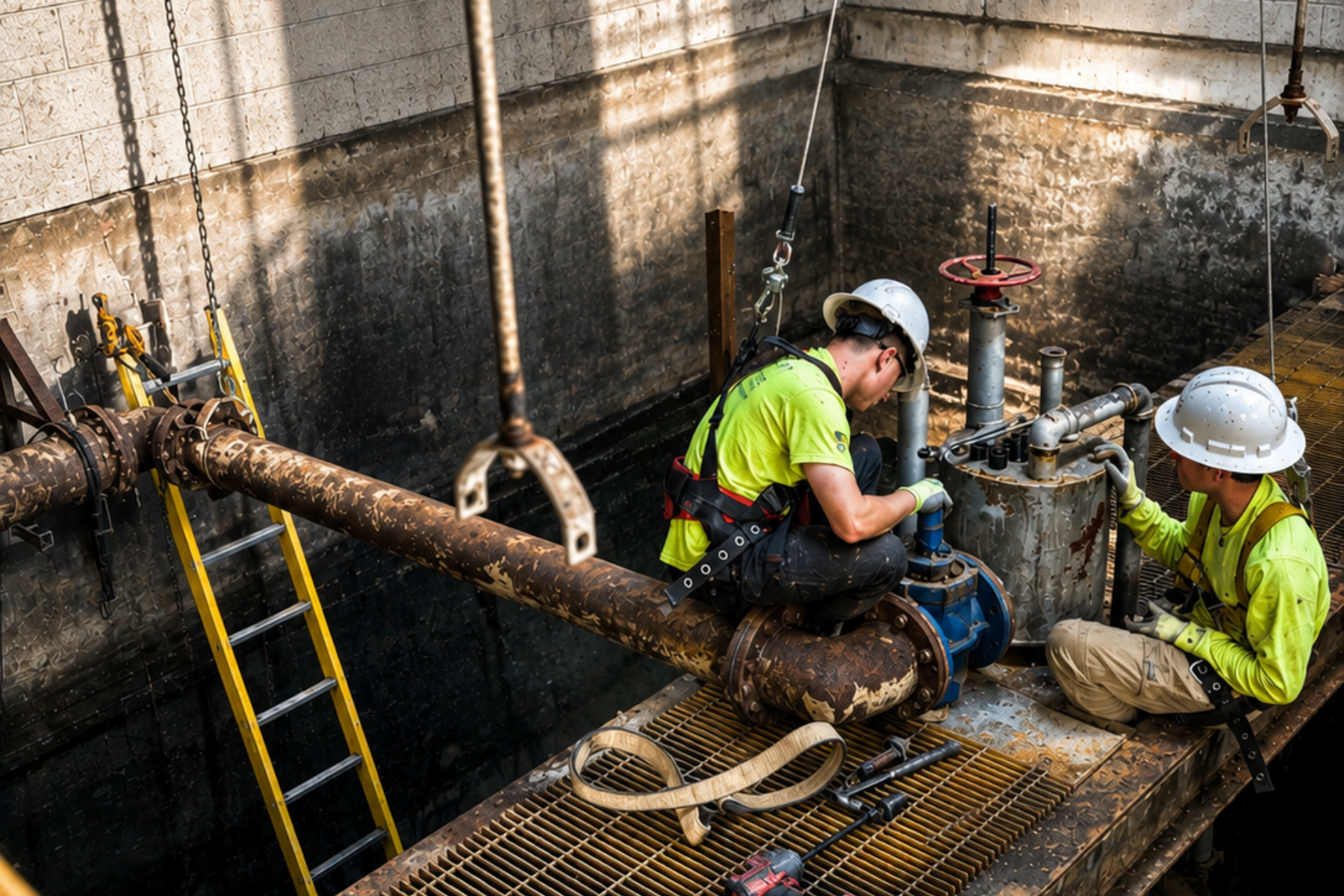
That capability recently went to work at the Bon Heur Pump Station in Macomb County, replacing four 8-ton screw pumps that had been lifting sewage more than 30 feet for 45 years. The work included new motors, electrical control equipment, a standby generator, a flow meter, and an odor control system — increasing station capacity from 40,000 to 50,000 gallons per minute. The pumps were replaced one at a time, keeping three in service at all times, so the station never went offline during the upgrade.
Inside a plant’s fence line, that same combination of trades applies. Pipefitting and mechanical crews handle process piping, cooling water lines, and backflow certification. Controls automation brings legacy pump and lift station controls up to current monitoring standards. Maintenance and repair keeps pumps, motors, and controls running on a predictive schedule instead of a crisis one. One team, one contract, no handoffs between trades.
Every person on a Lee project has a financial stake in doing it right — which matters on water infrastructure work, where a shortcut doesn’t show up until years later.
Practical Takeaways
- Water infrastructure is under the same demand and age pressure as the electrical grid, just less visible.
- Downtime, discharge violations, and stalled capital projects are the real costs of an unassessed system.
- Aging pumps and motors, tightening discharge regs, and competing regional demand are the three drivers to watch.
- A condition assessment on pumps, piping, and controls is the place to start, before a failure forces the timeline.
- Lee’s mechanical, electrical, and controls trades — backed by Midwest Power Systems’ municipal water and wastewater experience — cover the work from the plant fence line to the treatment plant.
FAQ
What counts as “water infrastructure” inside an industrial plant? Process water intake, cooling tower and makeup water systems, boiler feedwater, backflow prevention devices, and wastewater pretreatment before discharge. Anything that moves, treats, or discharges water on-site.
Why are industrial water systems under more strain now? Aging municipal and on-site infrastructure is reaching end-of-life at the same time large water users, including data centers, are drawing more heavily on the same regional systems, and discharge regulations keep getting stricter.
How do I know if my facility’s water infrastructure needs attention? Start with a condition assessment of pumps, valves, backflow devices, and piping. Facilities that haven’t had one in several years are the most exposed.
Can a contractor help before something actually fails? Yes. Predictive and preventive maintenance, plus capacity and condition assessments, are meant to catch problems before they become downtime.
Does Lee only work inside the plant, or on municipal water systems too? Both. Lee’s mechanical, electrical, and controls trades handle in-plant water systems, and Midwest Power Systems brings a municipal water and wastewater track record for treatment plants, lift stations, and pump stations.
CTA
If it’s been a while since anyone looked hard at the pumps, piping, and controls behind your plant’s water systems, that’s worth changing before a shortage or a permit issue forces the conversation. Contact Lee Contracting to talk through a condition assessment or a specific water infrastructure concern.
