

Voltage Sags in Manufacturing: Why Your Drives Keep Tripping and What Actually Fixes It
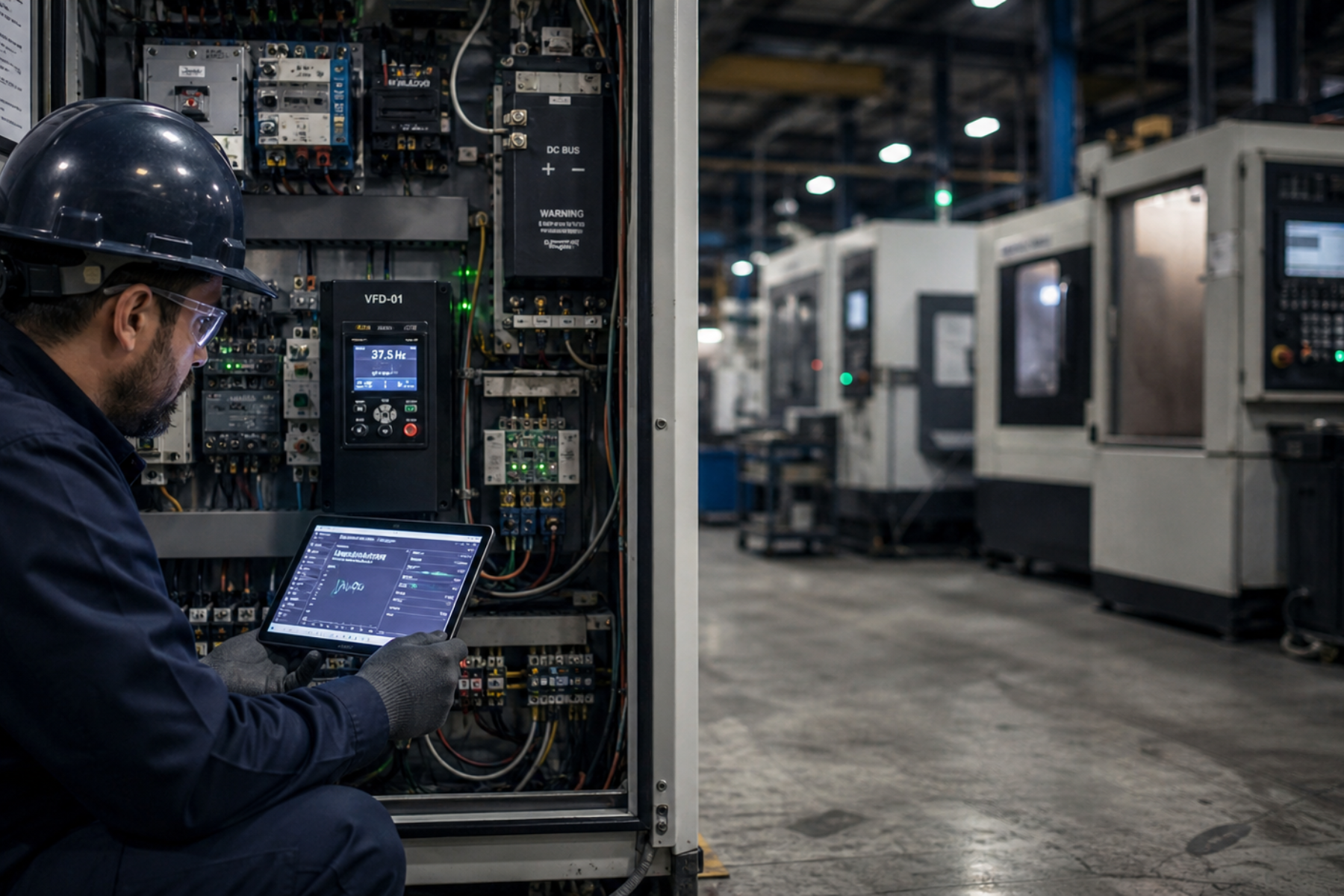
When a drive trips for the third time this quarter, most teams chase the drive. They pull diagnostics, swap a board, call the OEM, run a few quality checks, and put the line back into production. A few weeks later, the same trip shows up on the same circuit, sometimes on a different machine entirely.
The drive is rarely the actual problem.
In a growing number of plants, those repeat trips are symptoms of something happening on the other side of the panel: a voltage sag. A brief, often sub-second dip in supply voltage that the office building next door wouldn’t even notice, but that’s enough to drop a CNC mid-cycle, reset a PLC, or fault a VFD. The line stops. Recovery takes hours. Production loses ground that doesn’t show up on a maintenance work order, doesn’t trigger an alarm, and doesn’t make it into the morning huddle.
A recent piece in Manufacturing Dive made the point cleanly. Most facilities are flying blind on these events. The grid is older, demand is higher, and modern automation is far more sensitive than the equipment it replaced. Siemens’ 2024 True Cost of Downtime report put unplanned downtime across the world’s 500 largest manufacturers at $1.4 trillion a year, roughly 11% of revenue. The story for most facilities isn’t the catastrophic outage. It’s the steady drumbeat of small disturbances that keep clipping the same circuits.
Monitoring will tell you those events are happening. The harder question is what to do once you can see them.
What Voltage Sags Actually Are
A voltage sag is a short-duration drop in supply voltage, typically lasting between half a cycle and a few seconds. The most common causes sit outside the facility: a fault on a nearby utility feeder, a large motor starting somewhere on the grid, or a switching event at a substation miles away. The disturbance reaches the plant’s main electrical service without warning.
Two things make this worse than it used to be:
- The grid is aging. A significant share of U.S. transmission infrastructure is well past its original design life, which increases the rate of faults and switching events.
- Equipment is more sensitive. A line that tolerated a 15% dip ten years ago may trip at 10% today. Variable frequency drives, robotic cells, vision systems, and digitally controlled processes have lower disturbance thresholds than the relays and contactors they replaced.
Demand is also rising. NERC’s most recent long-term reliability assessment projects peak demand growth approaching 5% annually in some regions, driven by data centers, electrification, and industrial expansion. Feeders running closer to capacity transmit disturbances more readily.
The grid is getting less stable at the same time the floor is getting more sensitive. That gap is where voltage sags live.
The Three Fronts a Voltage Sag Exposes
Most plants treat sag events as a single problem, usually whichever piece of equipment shouts loudest. In practice, every event tests three different parts of the facility at the same time:
1. The Incoming Electrical Infrastructure
Service entrance, switchgear, transformers, distribution panels, grounding, and bonding. If any of those were sized, specified, or installed before the current generation of automation arrived, they may not be matched to today’s sensitivity needs. Loose connections, undersized neutrals, marginal grounding, or aging breakers can amplify the effect of a sag that better-conditioned infrastructure would shrug off.
2. The Control Systems
PLCs, VFDs, servo drives, HMIs, safety controllers, and the power supplies feeding them. Many of these have lower ride-through tolerance than the equipment they sit inside. A sag that doesn’t move a contactor will still drop a 24V control supply if it isn’t backed up. Once the controller drops, the line drops, even if the motors and machines were perfectly capable of riding through.
3. The Downstream Equipment
Motors, gearboxes, capacitors, sensors, and any component repeatedly cycled by sag-driven faults. This is the cost most plants never measure. Repeated under-voltage operation, sudden restarts, and incomplete shutdowns degrade components in ways that don’t trigger an immediate failure. They show up six months later as a bearing replacement, a motor rewind, or a control board failure with no obvious root cause.
You can’t fix any of these in isolation. A power monitor on the main panel won’t repair a stressed motor. A new VFD on one machine doesn’t address a switchgear issue feeding the rest of the line. The fix is electrical, controls, and mechanical work, often coordinated inside the same outage window.
Why Backup Generators Aren’t the Answer
A common first instinct is to ask whether the existing backup generator could cover the problem. It can’t. Standby generators are sized for full outages, and they take ten to thirty seconds to come online. A voltage sag is over in milliseconds. The line is already down before the genset even senses a problem.
Sag mitigation lives in faster-acting hardware: properly sized UPS systems for critical controllers, capacitor banks, isolation transformers where needed, dynamic voltage restorers for sensitive lines, or system-level energy storage at the service entrance for plants where the economics support it. Each option has different installation requirements, footprint considerations, and integration steps with existing distribution. None of them install themselves.
What Good Execution Looks Like
If a plant decides to take voltage quality seriously, the work usually moves through a sequence that looks something like this:
- Establish baseline data. Power quality monitoring at the main service and at a few representative panels, long enough to capture a meaningful event sample. Without it, every conversation about mitigation is based on guesses.
- Map the impact. Tie measured events to actual line stoppages. Which circuits, which controllers, and which equipment are taking the hits. The goal is to stop spending money protecting circuits that don’t need protection.
- Address the infrastructure first. Before adding mitigation hardware, fix what’s already underperforming: connections, grounding, undersized feeders, aging gear. A clean baseline makes mitigation more effective and easier to size.
- Add mitigation where it pays. UPS protection for critical controllers, machine-level conditioning for the most sensitive cells, larger system-level solutions where the economics extend beyond power quality alone, including peak demand management.
- Repair the damage already done. Motors, drives, and components that have been absorbing repeated stress events need inspection and, in many cases, refurbishment or replacement. Skipping this step means the next failure still happens, just later.
This sequence rarely fits cleanly inside a single trade. It involves electrical work at the service and panel level, controls and PLC work tied to the lines, and maintenance and repair on the equipment that’s been quietly taking the punishment. Coordinating those across multiple subcontractors is where most plant projects lose time and budget.
Where Lee Contracting Fits
Voltage sag work doesn’t fit neatly into a service catalog because it crosses several. That’s the part most plants find difficult to source. The infrastructure is electrical. The controls are a different specialty. The equipment repair is a third. The downtime window has to be coordinated against production. And someone has to own the whole sequence.
Lee Contracting is built for that kind of work. As a self-performing industrial contracting partner with master electricians, mechanical and pipefitting trades, fabrication, machine repair, and field execution under one roof, we routinely run projects that touch infrastructure, controls, and equipment inside the same outage. Whether that’s an electrical service upgrade, switchgear replacement, panel rework, control system modernization, or motor and drive repair on equipment that’s been wearing prematurely, the work moves through one accountable team rather than three or four.
That coordination matters more on power quality projects than most others, because the symptoms and the fixes don’t sit in the same place.
If your plant has been quietly accommodating repeat trips, running below capacity, or staggering startups to avoid drawing attention from the utility, those decisions are already costing you. Power quality work is one of the few places where a thoughtful capital project tends to pay back through both reliability and operating cost. Worth the diagnosis, at minimum.
For more on related infrastructure work, our recent piece on modernizing legacy industrial controls walks through how aging PLCs and control systems can be upgraded selectively rather than replaced wholesale, which is often a piece of the same conversation.
Frequently Asked Questions
What is a voltage sag in a manufacturing plant?
A voltage sag is a short-duration drop in supply voltage, typically lasting from half a cycle to a few seconds. The cause is usually external, such as a utility fault or a large motor starting on a shared feeder. Sags are too brief for backup generators to address but long enough to trip drives, reset controllers, and stop production lines.
How do you know if your plant is being affected by voltage sags?
The signature is repeat unexplained trips on the same circuits, PLCs that reset for no apparent reason, faults that don’t reproduce on the bench, and recovery times that consume hours of production. Power quality monitoring at the main service and key panels will quantify how often events are actually happening and how severe they are.
Will a UPS or backup generator stop voltage sags from disrupting equipment?
Backup generators won’t, because they take seconds to start and a sag is over in milliseconds. Properly sized UPS systems can protect specific controllers and critical loads. For broader coverage, plants typically combine UPS protection with capacitor banks, isolation transformers, dynamic voltage restorers, or system-level energy storage at the main service.
What kind of contractor handles voltage sag mitigation work?
The work usually requires master electricians for service and panel work, controls expertise for PLC and drive modifications, and mechanical and equipment repair for any motors or components stressed by repeated events. A single-source industrial contractor with all of these in-house can run the project as one coordinated outage rather than as three sequenced subcontractor efforts.
Can voltage sag damage be repaired without replacing equipment?
In many cases, yes. Motors, drives, and controllers that have absorbed repeated stress can often be inspected, repaired, or refurbished rather than replaced. The right answer depends on cumulative wear, age, and how integral the component is to the line. Catching it early is the variable that matters most.
Plan the Fix Before the Next Trip Costs You
Power quality issues don’t reach a clean breaking point. They get more frequent, more expensive, and more entangled with other reliability problems until something fails in a way that’s harder to recover from. The plants that get ahead of it are the ones that treat voltage events as an operational variable rather than a maintenance nuisance.
If you’re seeing repeat drive trips, unexplained PLC resets, premature equipment wear, or quietly running below capacity to manage the risk, it’s worth a conversation. Talk with our team about a power quality assessment, an electrical infrastructure review, or a coordinated outage that addresses the issue across infrastructure, controls, and equipment in one sequence. We’ll give you a clear read on what’s worth fixing, what isn’t, and what the work actually involves.
