

Modernizing Legacy Industrial Controls: How to Upgrade Aging Systems Without Replacing Everything
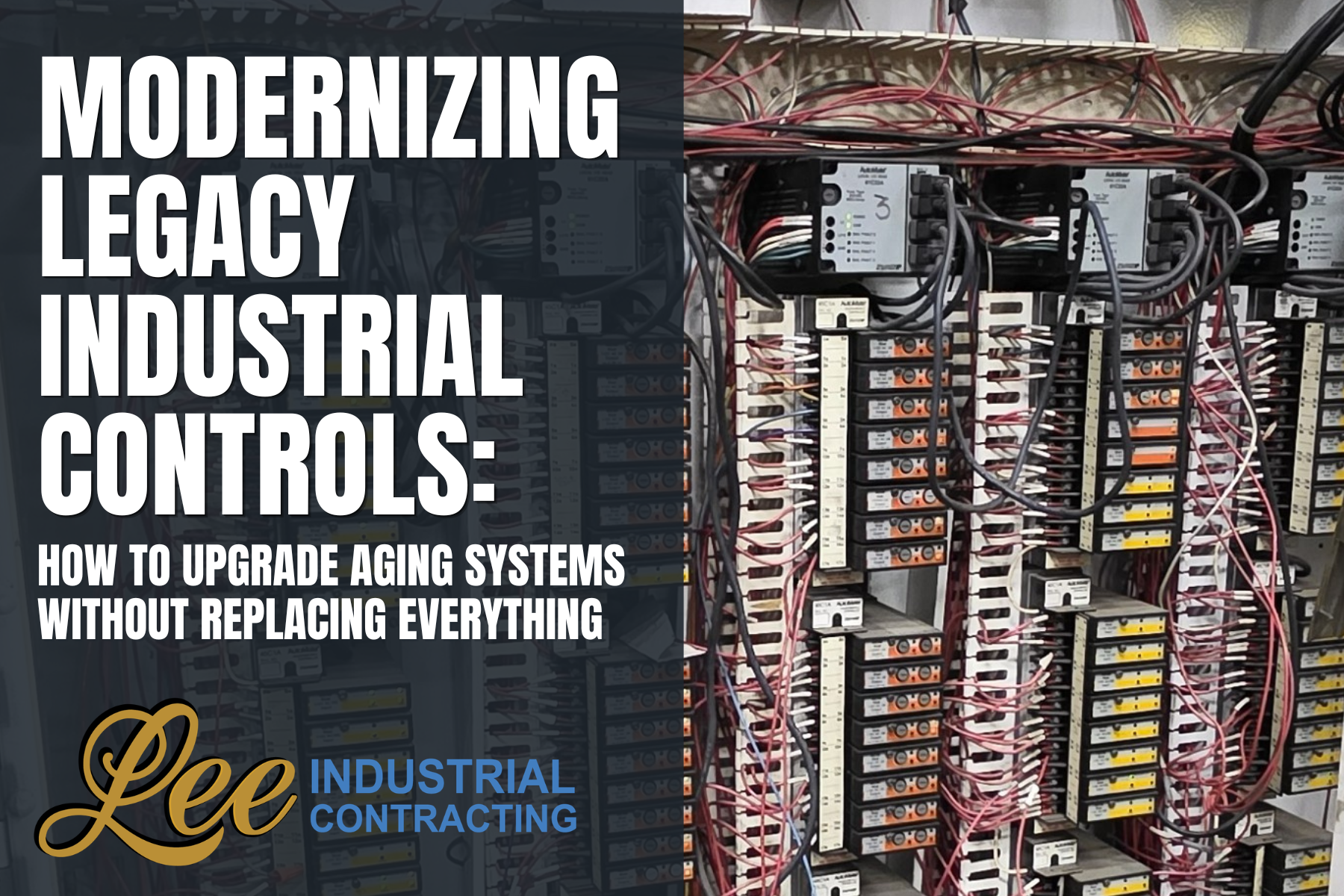
There’s a category of operational risk that plant managers and maintenance leaders carry quietly for years before it demands attention. It doesn’t trigger an alarm, doesn’t show up on a maintenance work order, and doesn’t appear in a production report — until it does. Then it’s usually a crisis.
That risk is an industrial controls system that has aged past the point of reasonable service.
Facilities running 20- and 30-year-old programmable logic controllers, discontinued hardware platforms, and control software that can no longer be updated are operating with a structural reliability problem that grows more serious every year. When legacy PLCs fail and replacement parts don’t exist, the repair becomes a project. When a system can’t communicate with modern monitoring or data infrastructure, the facility loses visibility it needs to manage operations effectively. When outdated controls can’t be patched against cybersecurity vulnerabilities, the OT network becomes an exposure point that IT and operations leaders are increasingly being asked to address.
This isn’t a problem that waits patiently for a scheduled capital project. It tends to surface at the worst possible time — during production, during an outage, or during a regulatory audit.
This guide covers what industrial controls modernization actually involves, how to evaluate your options without automatically committing to a full replacement, and how to execute an upgrade in a live facility without the production disruption that most facilities fear from this kind of project.
The Warning Signs That a Controls System Is Overdue for Modernization
Most facilities with aging controls systems already know it. The signs accumulate gradually and get normalized over time — until the cumulative picture becomes difficult to ignore.
Discontinued hardware with no available replacement parts. When a PLC processor, I/O module, or HMI panel fails and the manufacturer no longer supports the product, the facility’s response options shrink dramatically. Spare units pulled from decommissioned machines, third-party refurbished components, and used equipment from online surplus sellers become the de facto maintenance strategy. Each of those approaches has a limited shelf life, and none of them offers the performance or reliability of a supported platform.
Software that can no longer be updated or supported. Legacy control platforms often run programming software tied to specific operating system versions that themselves are no longer supported. When the software environment around the controls can’t be updated, the programming tools become fragile — dependent on aging laptops maintained specifically because they’re the only machines that will run the software. When those machines fail, accessing and modifying the control program becomes a significant problem.
No visibility, no data, no remote diagnostics. Modern facilities increasingly expect their control systems to communicate — to a SCADA system, to a manufacturing execution system (MES), to a historian for data capture, or at minimum to remote monitoring infrastructure that lets operators and maintenance teams see system status without standing in front of the panel. Legacy systems frequently have no meaningful data output beyond the local HMI display. In an era when production data is a competitive resource, a controls system that generates no usable data is a productivity limiter that extends well beyond its direct reliability risk.
Operators working around known system limitations. When experienced operators develop manual workarounds for control system behaviors that “just happen” — sequences that need to be manually reset, alarms that are acknowledged automatically because they’re always on, interlocks that are bypassed because they trip too frequently — the system has already failed in a functional sense. The operational knowledge required to work around it lives in the heads of the people who’ve been doing it for years, and it doesn’t survive turnover.
Increasing frequency of controls-related downtime events. If maintenance logs show a pattern of control system faults, I/O card failures, or unexplained machine stops that require controls troubleshooting to clear, the trend line is telling you something. Occasional failures on aging hardware are expected. Increasing frequency of failure on the same hardware indicates a system approaching end of useful life.
Cybersecurity exposure that can no longer be managed. Industrial control systems that predate modern cybersecurity awareness were designed for performance and reliability in isolated environments. They were not designed to operate on networks connected to enterprise IT systems, cloud infrastructure, or the internet. As facilities have added connectivity over the years — often without a coherent security architecture — legacy OT systems have acquired exposures they were never designed to carry. Unpatched operating systems, default passwords that can’t be changed, communication protocols with no authentication — these are common conditions on aging industrial controls, and they represent a genuine and growing risk.
What Industrial Controls Modernization Actually Involves
“Controls modernization” covers a spectrum of interventions — from targeted component replacements to complete platform migrations — and the right approach depends on the condition of the existing system, the facility’s operational constraints, and the investment level the modernization is expected to support.
Understanding the options before committing to an approach is how facilities avoid both over-investing in capability they don’t need and under-investing in a way that defers the real problem.
Component-level upgrade. Replace specific failing or obsolete components — a discontinued PLC processor, an aging HMI, a batch of end-of-life I/O modules — while maintaining the overall control architecture. This approach is appropriate when the system architecture is fundamentally sound, the remaining components have useful life remaining, and the primary driver is parts availability rather than platform obsolescence. It’s the most targeted and least disruptive option, but it doesn’t address the underlying platform limitations.
Panel upgrade with hardware replacement. Replace the control hardware inside the panel enclosure — new PLC platform, new I/O infrastructure, new HMI — while preserving the existing field wiring and devices. This approach delivers a modern hardware platform while avoiding the cost and disruption of replacing all field instrumentation and devices. The program migration is the primary complexity: converting legacy ladder logic from the old platform to the new one requires careful engineering to preserve machine behavior, and the conversion process needs to be validated thoroughly before cutover.
Full system replacement. New platform, new architecture, new field devices, new HMI and visualization. This is appropriate when the existing system is comprehensively obsolete — hardware, software, and architecture all at end of life — or when the scope of modernization includes significant new capability that the existing infrastructure can’t support. Full replacement carries the highest cost and the most cutover complexity, but it delivers a clean starting point with a fully supported, documented system.
Phased migration. A structured approach that moves through the modernization scope in planned stages — machine by machine, line by line, or function by function — maintaining production from the remaining legacy systems while each phase is completed and validated. Phased migration is the most operationally conservative approach for facilities that can’t accept an extended cutover event, and it allows lessons from early phases to inform later ones.
The right approach for any specific facility requires an honest assessment of the existing system’s condition, a clear definition of what the modernized system needs to do, and realistic evaluation of the operational constraints that will govern the migration.
Legacy PLC Systems: What’s Actually Out There in the Field
Understanding the landscape of legacy control platforms that are most commonly in service — and what their current status means for facilities running them — provides useful context for the modernization decision.
Lee Contracting’s controls automation engineers have more than 30 years of experience with legacy systems and comprehensive knowledge of the platforms that have been the workhorses of industrial manufacturing for decades. That depth of legacy knowledge matters enormously in a modernization project — a controls engineer who doesn’t understand the existing system can’t reliably convert it.
Allen Bradley (Rockwell Automation) legacy platforms. The Allen Bradley PLC-5 and SLC 500 series were dominant platforms in manufacturing through the 1990s and 2000s. Both have been moved to end of life by Rockwell Automation, with no ongoing support or new hardware production. Facilities still running these platforms are operating on borrowed time — spare parts are available through secondary markets, but supply is finite and inconsistent. Migration paths to the ControlLogix and CompactLogix families of Logix 5000 platforms are well-established, but they require program conversion, not just hardware swap.
Modicon legacy platforms. Schneider Electric’s Modicon 984 and Quantum series controllers, once dominant in process industries, are similarly aging out of active support in many configurations. Migration to the Modicon M340 and M580 platforms preserves the Modicon ecosystem while moving to current hardware and software — but legacy ladder logic conversion requires platform expertise.
Siemens S5 and older S7 platforms. Siemens S5 hardware has been discontinued for many years, and a substantial installed base remains in service in heavy industry and process manufacturing. The migration path to Siemens S7-1200 and S7-1500 platforms is technically well-defined but requires conversion of STEP 5 programs to TIA Portal, which is a non-trivial engineering effort.
Custom and proprietary systems. Some legacy control systems — particularly on specialized equipment like hydraulic presses, forging equipment, and hot stamping systems — involve proprietary control architectures that aren’t migrated through standard conversion paths. These require custom engineering to understand, document, and replace. Lee’s controls team has specific experience with mechanical and hydraulic press automation, hot stamping controls, and forging press systems — Aside from the mechanical press automation, Lee’s Contraols team has experience with Automotive Assembly Plant automation, HVAC automation and WWTP automation – exactly the equipment categories where proprietary legacy controls are most common. Regardless of the age of your automation, LEE controls team can help sort out the best path to update your legacy systems.
The Program Migration Challenge: Preserving Machine Knowledge
Of all the technical challenges in a controls modernization project, program migration is the one most likely to create problems if it’s handled carelessly — and the one most likely to be underestimated at the outset.
Legacy control programs carry decades of accumulated machine knowledge. The ladder logic that runs a stamping press or a transfer line doesn’t just execute motion sequences — it encodes the machine’s behavior in response to thousands of edge cases, safety conditions, alarm states, and operational modes that were discovered and resolved over years of production. That knowledge is embedded in the program, often without documentation, and sometimes without anyone in the current workforce who remembers why specific logic was written the way it was.
Migrating that program to a new platform is not a mechanical conversion exercise. It requires understanding what the program does, why specific logic was implemented the way it was, and whether the converted program replicates the intended behavior on the new hardware. A conversion that fails to preserve machine behavior produces a system that may execute correctly in test conditions and fail unexpectedly in production — which is worse than the legacy system it replaced.
A proper program migration process includes:
Documentation of the existing program. Before conversion begins, the existing program should be documented — I/O assignments, logic structure, timing parameters, alarm logic, and any undocumented machine-specific knowledge that can be extracted from the people operating the equipment. This documentation is valuable regardless of what happens next — it’s the baseline record that has often never existed before.
Functional analysis. Walk through the machine’s operational modes, startup sequences, safety interlocks, and fault conditions. Map the existing logic to functional behaviors. Identify sections of code that address known edge cases or historical failure modes. This is the engineering work that ensures the conversion captures what the program actually does — not just what it appears to do at a surface level.
Conversion and parallel testing. The converted program should be tested in a simulated environment before it goes near production equipment. Where possible, parallel operation — running both legacy and new systems simultaneously and comparing outputs — provides the most reliable validation. For complex machines, third-party controls integration testing may be appropriate.
Cutover planning. The moment of transition from legacy to new system is the highest-risk point in the project. It should be planned with the same rigor as any other critical production event: defined go/no-go criteria, a rollback plan if the cutover fails, production window selection that minimizes exposure, and direct communication with operations leadership throughout.
Cybersecurity and Legacy Industrial Controls: A Growing Operational Risk
Industrial cybersecurity has moved from an IT concern to an operational concern, and legacy controls systems are at the center of why.
The traditional model of industrial network security was physical isolation — OT networks weren’t connected to enterprise IT networks, and they weren’t accessible from outside the facility. That model has eroded significantly over the past decade as facilities have added remote access capability for vendor support, connected OT systems to ERP and MES platforms for production data, and integrated industrial networks with enterprise infrastructure in ways that weren’t planned with security architecture in mind.
Legacy control systems sit at the worst intersection of these changes. They were designed for performance and reliability in isolated environments. They run operating systems — often Windows XP or Windows 7 — that cannot be patched because the vendor doesn’t support updates and the risk of a patch breaking the control application is considered higher than the risk of the vulnerability. They communicate over protocols like Modbus and older EtherNet/IP implementations that have no authentication layer. And they often run with default passwords or no passwords at all because password management was never operationalized on these systems.
The result is a class of industrial systems that are increasingly connected — even if inadvertently — while being structurally unable to be secured with the tools available for modern systems.
The practical operational risks include:
Ransomware targeting OT networks. Ransomware incidents affecting industrial control systems have increased significantly. When a ransomware event reaches an OT network, the response options are limited: restore from backup if backups exist, rebuild the system if they don’t, or pay. Legacy systems with no backup strategy and no recovery plan are particularly vulnerable to extended production outages following a ransomware event.
Remote access vulnerabilities. Many facilities have remote access pathways to legacy systems — for vendor support, for remote monitoring, for engineering access — that were established without formal security controls. These pathways, often using old VPN configurations or direct internet-exposed interfaces, represent accessible entry points.
Lateral movement risk from enterprise network connections. A legacy PLC on the same network segment as enterprise systems creates a pathway for attackers who compromise the enterprise network to reach production systems. Network segmentation and properly configured demilitarized zones between IT and OT networks are standard security practice — but they require network infrastructure that many facilities haven’t invested in.
A controls modernization project is an appropriate time to address these issues. New hardware platforms support current security practices: encrypted communications, role-based access control, audit logging, and integration with network security monitoring tools. The modernization investment delivers cybersecurity improvement alongside reliability improvement — and the alternative of continuing to operate exposed legacy systems carries a risk that is increasingly difficult to justify.
Coordinating Controls Modernization With Physical Plant Work
Controls modernization rarely happens in a vacuum. The physical work that supports a controls upgrade — panel replacement, new enclosures, conduit and wiring, field device replacement — is an electrical scope that needs to be coordinated with the controls engineering work from the beginning of the project.
This is an area where separating the controls engineering from the electrical installation creates problems that an integrated contractor avoids.
When controls engineers and electricians are working under the same project management, the design decisions that affect the electrical scope — panel layout, I/O density, cable routing, termination approach — are made with input from both sides. Installation proceeds to a design that the controls engineers have already reviewed. Changes identified during installation are resolved within the team, not across contract boundaries.
When controls engineering is separate from the electrical contractor — which is the common arrangement when a facility uses a controls integrator for engineering and a separate electrical contractor for installation — the coordination burden falls on the facility. Design changes requested by the electrician go back to the controls integrator. Field conditions that affect panel layout require a design revision before installation can proceed. The facility manages the interface between two parties who may have never worked together and have different contractual incentives.
Lee Contracting’s controls automation capabilities include electrical controls design, electrical panel build, and programming of automation systems — integrated with our electrical installation capability under one project team. That integration is particularly valuable on controls modernization projects where the engineering and field work are tightly interdependent.
What Modern Controls Should Be Able to Do
A modernized controls system should deliver more than reliability and parts availability. The investment should produce a system that genuinely advances the facility’s operational capability. Here’s what that looks like in practice:
Real-time production data. Modern PLC platforms communicate natively with data historians, MES systems, and cloud-based monitoring platforms. Production counts, cycle times, downtime events, and quality data can be captured automatically and made available to operations management without manual data collection. For facilities that currently have no production data infrastructure, a controls modernization project is the enabling step.
Remote diagnostics and access. Properly secured remote access to control systems allows engineering and maintenance staff to diagnose faults, review alarm history, and make program modifications without requiring physical presence at the panel. This capability reduces response time for troubleshooting events and enables support from controls engineers who aren’t on-site.
Improved alarm management. Legacy control systems frequently have alarm structures that were added incrementally over years without systematic design — resulting in alarm floods during upset conditions where hundreds of alarms are active simultaneously and operators can’t identify the root cause event. Modern controls platforms support alarm management design that prioritizes, filters, and presents alarms in a way that operators can actually use.
Scalability for future additions. A modern controls platform can accommodate new equipment additions, process modifications, and capability expansions without requiring another major controls project. The investment in platform modernization should include appropriate spare I/O capacity and network architecture to support additions that are anticipated in the facility’s planning horizon.
Integration with ERP and scheduling systems. Modern controls can receive production orders from ERP systems, report completion data automatically, and participate in facility-level scheduling and performance tracking. This integration reduces manual data entry, improves schedule accuracy, and gives operations leadership better visibility into production status.
Building a Modernization Roadmap for Your Facility
The right approach to a controls modernization program at a multi-machine or multi-line facility isn’t usually a single large project — it’s a prioritized roadmap that addresses the highest-risk systems first and builds toward a cohesive facility-wide controls architecture over a defined horizon.
Building that roadmap starts with an honest inventory of what you have and what risk each system carries:
Criticality assessment. Which machines and lines are production-critical? A controls failure on a bottleneck machine has a different impact than the same failure on a low-utilization secondary line. Prioritize modernization by criticality first.
Parts availability assessment. For each legacy system, what is the actual availability of critical spare components? A system running on a platform where spares are still readily available carries less near-term risk than one where the last replacement processors are already on your shelf.
Condition assessment. Beyond parts availability, what is the actual condition of the existing hardware? Capacitors in aging power supplies degrade over time and fail predictably. Battery-backed memory systems lose their charge. Environmental exposure to heat, moisture, and vibration accelerates hardware aging. A physical inspection of legacy control panels by experienced controls engineers will reveal condition indicators that determine urgency more accurately than age alone.
Security exposure assessment. What network connections exist to legacy control systems? Is remote access enabled? Are default credentials in use? The security assessment informs the urgency of modernization for systems that carry elevated exposure.
With that inventory in hand, a modernization roadmap can be built that sequences projects by priority, aligns with planned maintenance windows and outage schedules, and defines a target end state for the facility’s controls architecture.
Lee Contracting’s Controls and Automation Capabilities
Lee Contracting’s controls automation team brings more than 30 years of experience with legacy and current control platforms — including Allen Bradley, Siemens, Modicon, Wintress and custom systems on presses, forging equipment, hot stamping lines, and process systems. We handle the full scope of controls modernization: electrical controls design, electrical panel build, program conversion and validation, and commissioning support.
That controls capability is integrated with our electrical installation team, our maintenance and repair capabilities for the mechanical systems that controls govern, and fabrication for panel enclosures and support structures — all under one project management team that coordinates the engineering and field work without handoff gaps.
We also understand the production environments where this work happens. Our automotive and heavy industry experience means we know how to plan controls work around production schedules, execute cutovers in compressed windows, and communicate with plant operations teams throughout the project. Controls modernization done well doesn’t stop production — it’s planned and executed so carefully that operations leadership is confident the restart will go cleanly.
Browse our project portfolio to see the range of industrial work we execute across facilities that demand this level of planning and precision.
If your facility is running on legacy controls that are limiting your reliability, your visibility, or your ability to keep the system secure, contact Lee Contracting to talk through what a modernization assessment looks like. Or request a quote and let’s start the conversation about your specific systems.
Frequently Asked Questions
How do I know if my industrial control system needs to be modernized? The most reliable indicators are: discontinued hardware with limited or no spare parts availability, software that can no longer be updated or supported, no data output capability to modern monitoring or MES systems, operators working around known system limitations as a matter of routine, increasing frequency of controls-related downtime events, and cybersecurity exposure from legacy platforms on connected networks. Any one of these is worth taking seriously. Multiple indicators together signal a system that has moved past manageable maintenance and into structural risk territory. Lee Contracting’s controls team can assess your specific systems and give you an honest picture of where you stand.
What is the difference between upgrading and replacing an industrial PLC system? An upgrade replaces specific failing or obsolete components while maintaining the overall control architecture — a new processor, a new HMI, a batch of replacement I/O modules. A replacement involves migrating to a new hardware platform and converting the control program to run on that platform, either within the existing panel enclosure (panel upgrade) or with entirely new field infrastructure (full system replacement). The right approach depends on the condition of the existing system, the extent of obsolescence, and what capability the modernized system needs to deliver. Lee Contracting’s controls automation engineers assess existing systems and recommend the approach that matches the actual condition and requirements.
How do you modernize industrial controls without stopping production? The key is phased planning and cutover execution that matches the modernization timeline to planned production windows. Panel builds and program development happen off-line. Testing and validation happen before the cutover event. The cutover itself is planned for a scheduled maintenance window with defined go/no-go criteria and a rollback plan if problems arise. For multi-machine facilities, a phased migration approach moves system by system, maintaining production from the remaining legacy systems while each phase is completed. Lee’s Power of One model — controls engineers, electricians, and field crews under one project manager — makes this coordination achievable without the handoff gaps that create cutover risk.
What are the cybersecurity risks of legacy industrial controls? Legacy industrial controls commonly run on unpatched operating systems, use communication protocols with no authentication layer, and have default credentials that were never changed because password management was never operationalized on these systems. As OT networks have become more connected to enterprise IT infrastructure and remote access pathways, these systems have acquired exposure they were never designed to carry. The practical risks include ransomware targeting OT networks, unauthorized access through remote access pathways, and lateral movement from enterprise networks through insufficiently segmented OT segments. A controls modernization project delivers hardware and software platforms that support current security practices — encrypted communications, role-based access control, and integration with network security monitoring.
What legacy PLC platforms does Lee Contracting have experience with? Lee Contracting’s controls automation team has more than 30 years of experience with legacy systems including Allen Bradley (AB) and Modicon platforms — two of the most widely deployed legacy PLC families in industrial manufacturing. We also have specific experience with custom and proprietary control systems on mechanical and hydraulic presses, forging equipment, hot stamping systems, and hydroforming equipment — categories where non-standard legacy controls are most common. This depth of legacy knowledge is essential for program conversion work: you can’t reliably migrate a control program you don’t fully understand.
Should electrical installation and controls engineering be handled by the same contractor? For controls modernization projects, having electrical installation and controls engineering under the same contractor significantly reduces the coordination complexity and risk. Design decisions that affect the electrical scope — panel layout, I/O infrastructure, cable routing, field device selection — are made with input from both sides. Field changes are resolved within the team. Cutover planning integrates both engineering and installation perspectives. When these functions are split between a controls integrator and a separate electrical contractor, the facility manages the interface between them — absorbing coordination overhead and exposure to gaps between what was designed and what gets installed. Lee Contracting integrates both capabilities under one project team.
