

Cold-Weather Concrete for Equipment Foundations: Planning the Protection Period Around Your Install Date
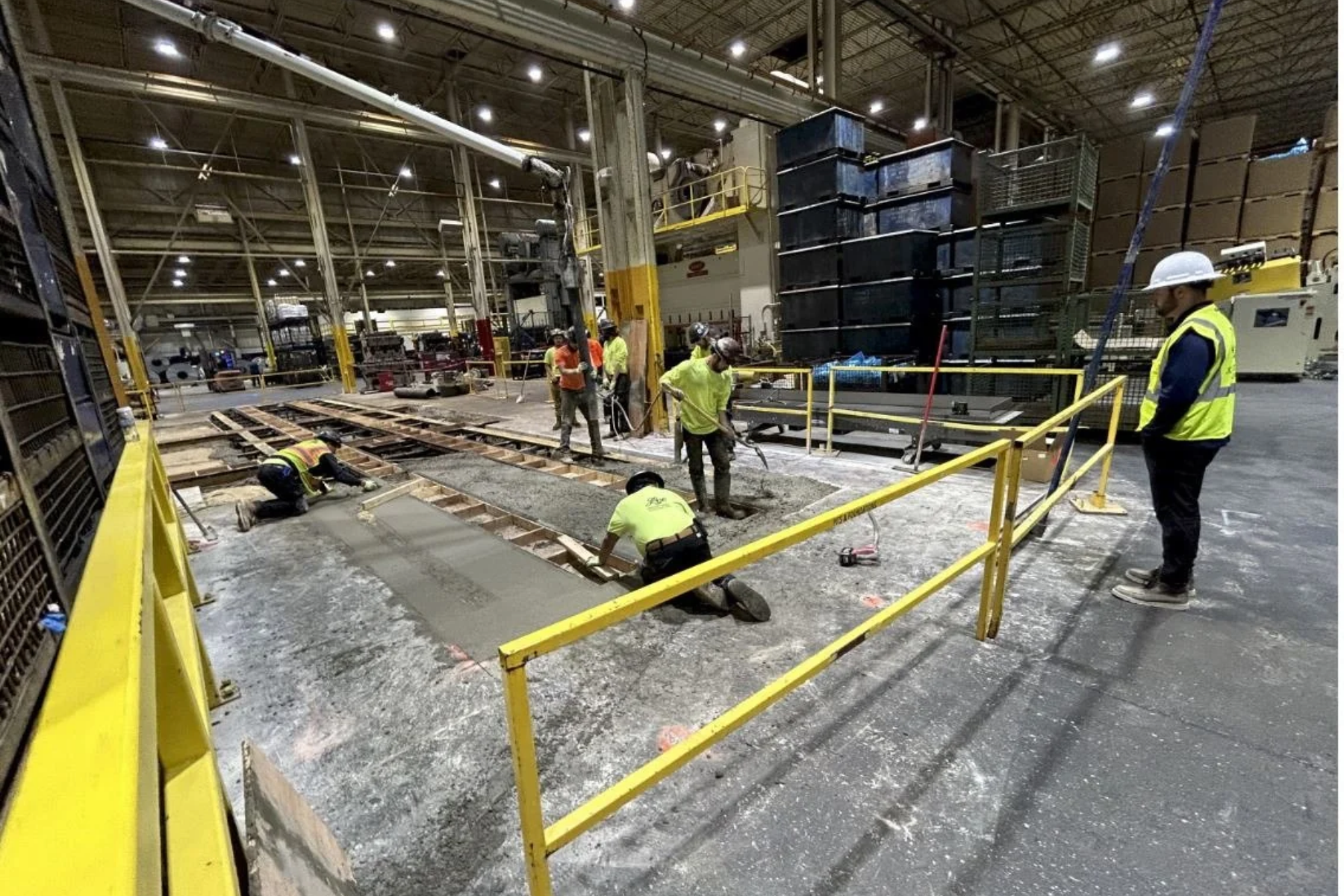
Project engineers planning a winter equipment install are usually working backward from a date: when the machine ships, when the riggers set it, and when production needs it running. For cold-weather concrete on an equipment foundation, that date depends on three things the concrete controls: how long the pour has to be protected, how fast it gains strength at the temperature you can hold, and when the baseplate can be grouted. Build the protection period and strength verification into the install schedule from day one, and a winter pour runs on a predictable timeline.
In a heated, running plant, most of this barely applies. It applies to new buildings, additions, bays with an open wall, and pads near dock doors or exterior walls, which is where a lot of winter equipment installs actually happen.
When does cold weather affect an equipment foundation pour?
Cold weather affects a pour any time the air around the concrete falls, or is expected to fall, below 40°F during the protection period. That’s the definition in ACI 306R-16, the American Concrete Institute’s guide to cold-weather concreting, and it’s based on conditions at the pour, not the calendar.
For equipment foundations, the questions to ask are:
- Is the building enclosed and heated? A shell under construction or an addition tied into an existing plant usually isn’t, at least not yet.
- Is the subgrade frozen? Concrete shouldn’t be placed on frozen ground, and pits dug in winter can freeze at the bottom overnight.
- Will the pad sit near an opening? Dock doors and temporary wall openings can drop the temperature at one end of a pour well below the rest of the building.
What does ACI 306 require for cold-weather concrete on equipment foundations?
ACI 306 sets three goals for cold-weather concrete: protect it from freezing until it reaches about 500 psi, keep it warm enough to keep gaining strength, and bring it back to ambient temperature slowly enough to avoid cracking.
The 500 psi threshold matters most. Freezing before the concrete reaches that strength can cut its ultimate strength by as much as half.
The minimum concrete temperature depends on the section’s least dimension, because thicker sections hold their own heat longer. The same table limits how fast the surface can cool once protection comes off.
| Least dimension of section | Minimum concrete temperature, as placed and maintained | Maximum surface temperature drop in the first 24 hours after protection ends |
|---|---|---|
| Under 12 in. | 55°F | 50°F |
| 12 to 36 in. | 50°F | 40°F |
| 36 to 72 in. | 45°F | 30°F |
| Over 72 in. | 40°F | 20°F |
Source: ACI 306R-16, Guide to Cold Weather Concreting. Your project specification and engineer of record govern.
Equipment foundations often fall in the bottom two rows. A thick pad needs a lower placement temperature, but it also needs the slowest cool-down.
How long does the protection period need to be?
The protection period depends on what the foundation has to do next. ACI 306’s minimum protection periods cover keeping the concrete from freezing damage, and for a lightly loaded section that can be as short as one or two days at the required temperature. An equipment foundation also has to reach the strength the engineer of record requires before anchor bolts are tensioned, grout goes in, and the machine is set.
That required strength is a project-specific number, set from the equipment data and the foundation design. Our guide to getting an equipment foundation right before the pour covers where those requirements come from. In cold weather, the practical answer is to keep the concrete protected and above its minimum temperature until testing confirms it has reached that strength.
How do you know when the foundation is strong enough to grout and set the machine?
Confirm in-place strength by measurement. The usual tools are:
- Field-cured cylinders. Cylinders cured next to the pour, under the same enclosure and heat, show what the foundation itself is doing. Lab-cured cylinders at standard temperature will overstate in-place strength in cold weather.
- Maturity monitoring. Temperature sensors cast into the foundation track its temperature history, and a strength curve calibrated to the specific mix converts that history into an in-place strength estimate in real time. It’s the best tool for deciding when protection can step down and when the install can proceed.
- Cores. When there’s a question about in-place strength, cores taken from the foundation settle it.
Agree on which method will be used, and who signs off, before the pour. Arguing about it after the machine has arrived costs more than the testing does.
Can you grout an equipment baseplate in cold weather?
Yes, as long as the grout, the concrete surface, and the air around them stay within the grout manufacturer’s temperature limits through placement and cure. Both epoxy and cementitious grouts publish minimum temperatures on their data sheets, and cold slows their cure the same way it slows concrete.
In practice, that means keeping the enclosure and heat in place through grouting, conditioning the grout materials before mixing, and checking the foundation’s surface temperature as well as the air. Surface preparation still applies in full: chipped and cleaned concrete, controlled moisture, and sealed forms.
How do you build the protection period into the install schedule?
Work backward from the install date, and treat enclosure, heat, and strength verification as scheduled tasks.
- Set the targets with the engineer of record. The required strength before grouting and setting, the testing method, and the sign-off process.
- Plan enclosure and heat before the pour. Temporary walls, indirect-fired heaters vented outside the enclosure, insulated blankets, and fuel for the full protection period.
- Protect the subgrade and forms. Thaw and cover the excavation, and keep the anchor bolt template, rebar, and embeds free of ice and snow.
- Work the mix with your ready-mix supplier. Heated water or aggregates, and accelerators where the specification allows them.
- Monitor through the protection period. Track concrete temperature continuously and log it against the ACI minimums.
- Step protection down gradually. Keep the surface temperature drop within the limits for the section size.
- Grout, cure, then set. Hold the enclosure through grout cure, then rig, set, and align the equipment.
Each step adds time and cost, but it’s predictable time. A schedule that includes it from the start doesn’t slip when the weather turns.
When should you bring in a contractor?
Bring in a contractor with cold-weather foundation experience when the pour is in an unheated or partially open space, when the section is thick enough that cracking is a real concern, or when the same team needs to carry the foundation through grouting and equipment setting on a fixed date.
Why Lee Contracting?
Lee self-performs equipment foundations, fabrication of embeds and anchor bolt frames, rigging, and electrical under one project manager, so the cold-weather plan covers the whole sequence from pour to set.
At a steel processing plant in Crawfordsville, Indiana, Lee poured foundations for a steel slitting line in the middle of winter while the building was still partially open. The crew put up temporary walls with panel doors that held the heat in and still let concrete trucks and equipment through. Lee’s fabrication team built the embedded steel and anchor bolt frames, and once the concrete cured, Lee’s riggers set, aligned, and anchored the line on the new foundations.
For Visioneering in Auburn Hills, Michigan, Lee poured foundations for eight large milling machines on frozen ground while the new facility was being built around them. The work totaled 2,320 cubic yards of concrete, with 750 placed in a single day, and all eight machines set without problems.
Every person on a Lee crew is an employee-owner, with a stake in your install date holding.
Practical takeaways
- Cold weather is defined by conditions at the pour: air at or below 40°F during the protection period.
- Protect fresh concrete from freezing until it reaches about 500 psi, and hold the ACI 306 minimum temperature for the section size.
- Thick equipment foundations need a lower placement temperature but the slowest cool-down.
- Confirm in-place strength with field-cured cylinders or maturity monitoring before grouting and setting.
- Keep enclosure and heat in place through grout cure, within the grout manufacturer’s limits.
- Schedule enclosure, heat, and strength verification as tasks, working back from the install date.
FAQ
What temperature counts as cold weather for concrete? ACI 306R-16 defines cold weather as any time the air temperature has fallen to, or is expected to fall below, 40°F during the protection period. It’s based on conditions at the pour, so an unheated building in November can qualify.
How strong does concrete need to be before it can freeze? About 500 psi. Concrete that freezes before reaching that strength can lose as much as half of its ultimate strength, so it has to be protected until testing or a maturity estimate confirms it’s past that point.
When can equipment be set on a foundation poured in winter? When in-place testing confirms the foundation has reached the strength the engineer of record specified for grouting and loading. Field-cured cylinders or maturity monitoring give that answer; lab-cured cylinders at standard temperature will overstate it in cold weather.
Can you grout an equipment baseplate in cold weather? Yes, if the grout, the concrete surface, and the surrounding air stay within the grout manufacturer’s published temperature limits through placement and cure. That usually means keeping the enclosure and heat in place until the grout has cured.
Why do thick equipment foundations crack in cold weather? Usually from cooling too fast when protection comes off, which creates a large temperature difference between the surface and the core. ACI 306 limits the surface temperature drop in the first 24 hours after protection ends, and the limit gets tighter as sections get thicker.
If you have an equipment install landing this winter in a new building, an addition, or a space that isn’t fully heated, request a quote and we’ll plan the foundation, protection period, and setting around your install date.
