

Plant Freeze Protection: What Freezes First and What to Check Before Winter
Maintenance leaders heading into the first hard freeze are protecting the same short list every year: lines where water sits still, lines that run through cold space, and the safety equipment that has to work on the coldest morning of the year. Good plant freeze protection comes down to three checks on each of those lines before temperatures drop. Is it insulated? Is it heated? Can it drain?
In most cases, the work is a walkdown, a round of heat trace and heater testing, and a handful of repairs to insulation and drains. A few days of scoped work in the fall keeps those lines in service through January.
Which systems in a plant freeze first?
The lines that freeze first are the ones where water doesn’t move and the ones that run through unheated or wind-exposed space. Small-bore lines freeze faster than large ones because there’s less water holding heat.
- Dead legs and seldom-used branches. Capped lines from removed equipment, bypass loops, and hose stations that see use twice a year. No flow means no heat.
- Emergency eyewashes and safety showers. These often sit at the end of a long branch, near dock doors, or outdoors at tank farms and unloading areas.
- Instrument and sensing lines. Small-bore tubing to pressure transmitters and flow meters freezes fast, and it usually throws bad readings before it ever splits.
- Cooling tower makeup and basin piping. Outdoor, exposed, and often sitting idle on cold days when tower load drops. It’s one of the plant water systems worth a regular condition check.
- Compressed air drops, drains, and dryers. Moisture collects at low points and drain valves. A frozen auto drain sends water downstream into tools, valves, and controls.
- Dry-pipe sprinkler low points. Condensate settles in low points and auxiliary drains and can freeze even though the system is filled with air.
- Interior lines near dock doors, wall openings, and roof penetrations. Piping inside the building freezes when a door sits open through a shift change or a unit heater quits overnight.
What should you check before the first hard freeze?
Before the first hard freeze, walk every at-risk line and confirm three things: the heat source works, the insulation is dry and intact, and anything idle is drained or isolated. Start early enough to order parts, since heat trace components and heaters aren’t always on the shelf.
- Walk the plant with a list. Mark each at-risk line on a drawing or in your CMMS, with its heat source and its drain point. Anything that froze last winter goes on the list first.
- Test heat trace circuits. Confirm controllers and thermostats switch on at setpoint, run an insulation resistance test on each circuit per the manufacturer’s maintenance manual, and check breakers and ground-fault protection. Heat trace rarely shows a visible sign when it stops working.
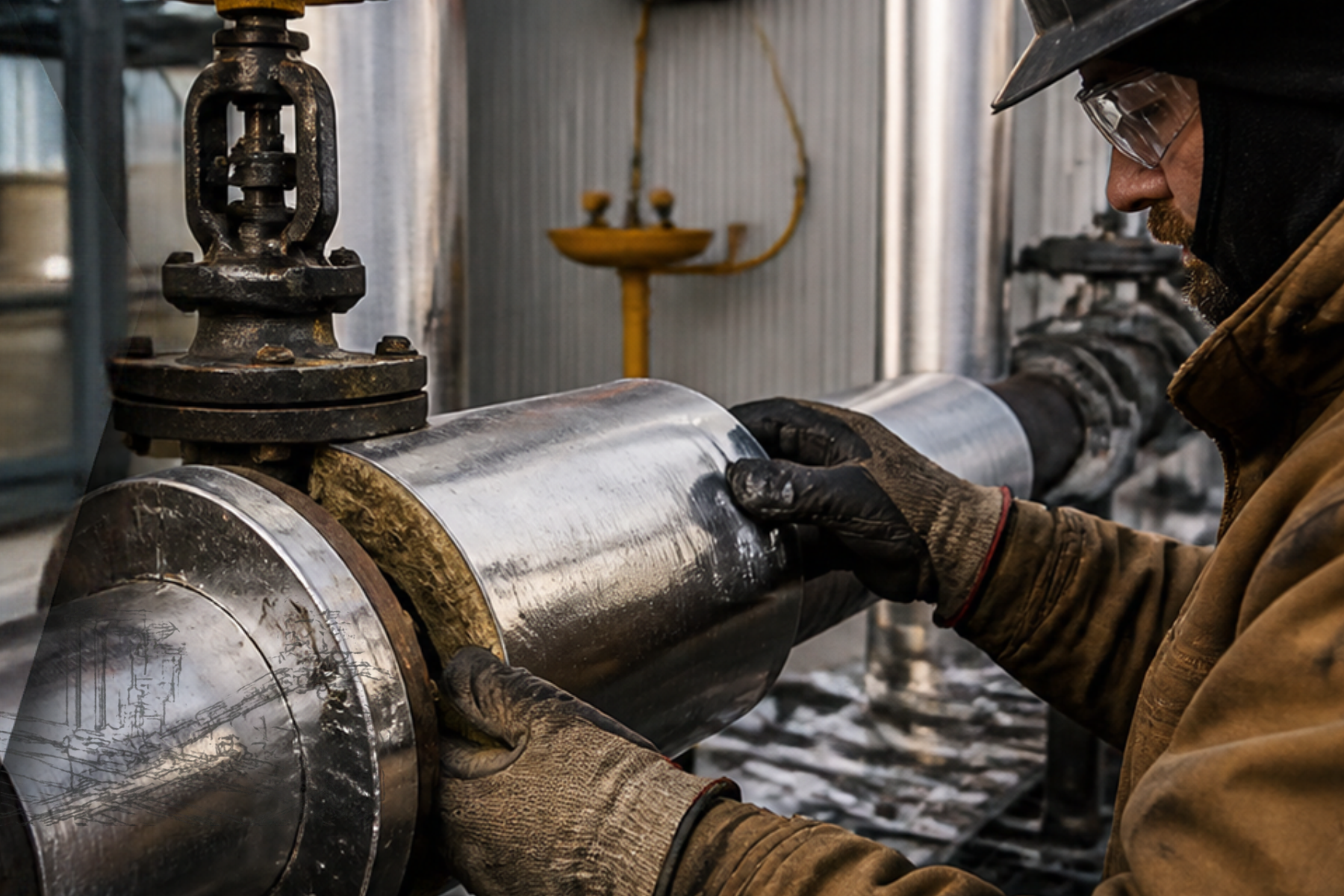
- Inspect insulation and jacketing. Wet, crushed, or missing insulation does very little, and wet insulation can make the heat trace under it ineffective. Replace damaged sections and reseal jacketing at hangers, valves, and fittings, where gaps usually start.
- Fire every unit heater and infrared tube heater. Run them this month and check the thermostats closest to the lines they protect.
- Test glycol in closed loops. Check the freeze point in chilled water and process cooling loops, especially any loop that’s been topped off with straight water during the year.
- Drain or isolate what’s idle. Blow down seasonal lines, open low-point drains, and tag isolation valves so nobody refills a line that was drained on purpose.
- Service compressed air drains and dryers. Confirm auto drains are discharging, dryers are running, and drop legs in perimeter or outdoor locations are protected.
- Stage a freeze-response kit. Keep insulation, pipe repair clamps, temporary heaters, and a short call list for a burst line at 2 a.m. in one known place.
How do you keep eyewashes and safety showers working in winter?
Emergency eyewashes and safety showers need water that’s tepid, not just unfrozen. ANSI/ISEA Z358.1 defines tepid flushing fluid as 60 to 100°F, and plumbed units have to deliver it for a full 15-minute flush.
A supply line can stay liquid all winter and still run too cold to use. Someone flushing a chemical splash with near-freezing water is likely to stop early, which works against the whole purpose of the unit.
The usual fixes, depending on location and hazard:
- Heat trace and insulation on the supply line all the way to the unit
- A freeze-protected or heated enclosure for outdoor units
- A thermostatic mixing valve fed from a hot water source
- Moving the unit indoors, where the 10-second travel requirement still allows it
Check outlet temperature during the weekly activation test along with flow. Winter is when that number drifts.
What should you do when a line freezes or bursts?
When a line freezes, isolate it, protect the area, thaw it slowly with no open flame, and repair any damage before you restore pressure.
- Frozen but intact: Close the upstream valve and open a downstream drain or fixture so meltwater and pressure have somewhere to go. Thaw from the open end back toward the ice with heat guns, heating blankets, or warm air. Skip the torch. Open flame can overheat the pipe and puts a fire risk next to insulation and process lines.
- Burst: Isolate the line, shut down any equipment it serves, de-energize electrical gear in the wet area, and contain the water before anyone starts the repair.
- No good isolation point: When the nearest valve is far upstream or won’t hold, pipe freezing can limit the shutdown. A crew uses liquid nitrogen to form an ice plug on either side of the damaged section, which isolates the repair without draining the whole system. Flow has to be stopped at the freeze point for the plug to form, but a fire main, cooling loop, or process line can often stay in service around the work.
- After the repair: Pressure test the line, check the fittings next to the damage, and find out why it froze. A dead heat trace circuit, wet insulation, or a door that stays open will freeze the same spot again next cold snap.
When should you bring in a contractor for plant freeze protection?
Bring in a contractor when the walkdown turns up more work than your team can finish before temperatures drop, or when the fix crosses trades. Most plant maintenance teams handle the walkdown and routine heater checks well on their own.
Outside help makes sense when:
- Insulation and heat trace repairs add up to more than a few weeks of in-house labor
- Dead legs need to be removed, or at-risk lines need rerouting or new low-point drains
- An eyewash or safety shower needs a tempered water supply
- A line you can’t easily drain, like a fire main or cooling loop, needs a repair
- New or replacement unit heaters need to go in, along with the power to run them
Why Lee Contracting?
Freeze protection touches several trades, and Lee’s pipefitting and mechanical crews cover most of them under one project manager. That scope includes pipe insulation installation, pipe freezing for isolated repairs, unit heater and infrared tube heater installation, compressed air dryer and auto drain service, fire suppression system work, and 24/7/365 emergency response. Crews pull parts from Lee’s in-house inventory, so a burst line doesn’t wait on a supply run.
When a fix needs new power, like a circuit for an added unit heater, Lee’s industrial electricians work under the same plan. For plants that want winter prep on the calendar every year, Lee’s maintenance and repair team builds preventive work around your production schedule.
Every person on a Lee crew is an employee-owner. The pipefitter insulating your eyewash supply line has a stake in whether it works on the coldest morning of the year.
Practical takeaways
- The lines that freeze first are the ones with no flow or the ones running through cold space: dead legs, eyewashes, instrument lines, cooling tower makeup, compressed air drains, and dry-pipe sprinkler low points.
- Check three things on every at-risk line before the first hard freeze: working heat, dry insulation, and a way to drain.
- Heat trace usually stops working without a visible sign, so test every circuit with a meter each fall.
- Eyewashes and safety showers need tepid water, 60 to 100°F under ANSI/ISEA Z358.1, which is a higher bar than staying unfrozen.
- Thaw frozen lines slowly with no open flame, and fix the cause before the next cold snap.
- Pipe freezing can isolate a burst section without draining the whole system.
FAQ
When should a plant start winterizing? Start in early fall, several weeks before the first hard freeze. That leaves time to order heat trace components, insulation, and replacement heaters, and to finish repairs before the first cold night tests them.
How do you test heat trace? Confirm each controller or thermostat switches on at its setpoint, then run an insulation resistance test on every circuit following the manufacturer’s maintenance manual. Check breakers and ground-fault protection too, since heat trace often stops working without any visible sign.
What temperature does an emergency eyewash need to be? ANSI/ISEA Z358.1 calls for tepid flushing water, defined as 60 to 100°F, delivered for a full 15 minutes. Outdoor and cold-area units usually need heat trace, a heated enclosure, or a thermostatic mixing valve to stay in that range.
How do you safely thaw a frozen pipe in a plant? Close the upstream valve, open a downstream drain so meltwater has somewhere to go, and thaw slowly from the open end with heat guns, heating blankets, or warm air. Never use an open flame, which can overheat the pipe and create a fire risk.
Can you repair a pipe without draining the whole system? Often, yes. Pipe freezing uses liquid nitrogen to form an ice plug on each side of the damaged section, isolating it for repair while the rest of the system stays filled. Flow must be stopped at the freeze point for the plug to form.
If you’d like a second set of eyes on your at-risk lines, or you need insulation, heater, or drain work finished before winter, request a quote and we’ll scope it with you. For a line that’s already frozen or burst, Lee’s emergency service runs 24/7/365
